How to oil a mechanical watch movement: The ultimate beginner's guide
The ultimate beginner's guide to doing it right: from shock jewels to the keyless works.
Oiling is the most dreaded step of servicing a watch. Yet, it's also the one that makes the biggest difference between a watch that runs strong for 5 years and one that ends up back on the bench 6 months later.
This guide gathers the essentials a beginner needs to know, avoiding common mistakes, especially the two most widespread ones: over-oiling and oiling the wrong places.
Table of Contents
1. Why lubricate a mechanical watch?
A mechanical movement is made of dozens of metal parts in constant contact: pivots in their hole jewels, interlocking gears, and an unwinding mainspring. Without lubrication, this friction generates wear. On a typical watch, there are over fifty friction points to treat.
Lubricants serve two distinct functions depending on where they are applied: reducing friction in pivot areas (light and intermediate oils) and reducing sliding wear under pressure in high-force areas (greases).
Modern synthetic oils do not solidify like the vegetable or animal oils of the past. Depending on conditions (the watch's water resistance, temperature, humidity...) they either gradually evaporate or oxidize and thicken, slowly losing their effectiveness. In both cases, a watch that hasn't been serviced in 5 years will eventually run dry on its pivots, even if it seems to be working normally. Wear is silent and accumulates.
2. The golden rule: never oil without cleaning first
This is the number one rule, with no exceptions. You only oil a movement after it has been completely cleaned and dried. Oiling a dirty movement is worse than not oiling it at all: the old oil residue, dust, and metal particles mix with the new oil to form a true grinding paste that accelerates wear on pivots and jewels.
Applying oil without cleaning only provides a temporary benefit and worsens the situation in the long run.
3. Essential tools
The oiler
The oiler is the tool used to apply oil with precision. There are several types:
- Standard oiler: The most common. A handle with a steel tip. You dip the tip into the oil cup and apply. Simple, inexpensive, perfect for beginners.
- Automatic oiler: Deposits an exact amount at the push of a button. Not suited for hobbyists working on various movements.
What tip size to choose? For beginners, a 0.2 mm tip (fine) is versatile and works for almost all oiling points on a standard movement.

Close-up: Striated oiler tip (left) vs Polished tip (right)
The oil cup (and the micro-dose method)
The traditional rule requires never taking oil directly from an original bottle to avoid contaminating the entire stock. You must traditionally use an individual oil cup.
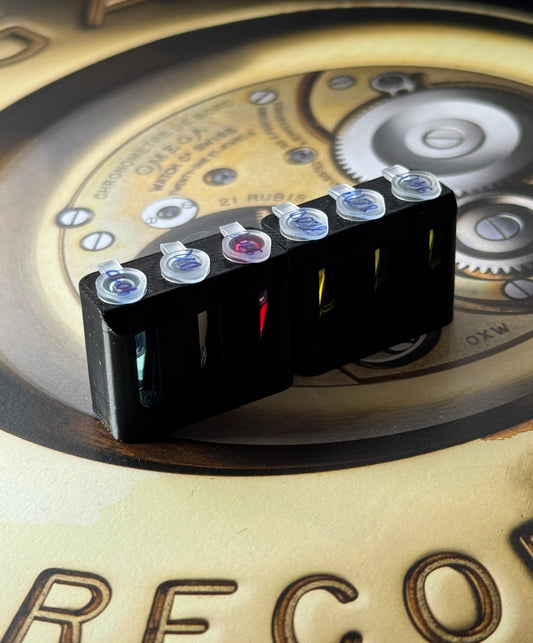
However, a more modern approach involves working directly with micro-doses on 3D-printed stands. The tubes, featuring a conical bottom, allow any potential micro-debris to sink and be trapped. While transferring a drop to an oil cup remains the ideal professional protocol, this conical design allows watchmakers to dip their oilers directly into the tube safely, offering great convenience and saving time when cleanliness rules are respected.
Rodico
Rodico is a pliable putty used to absorb a slight excess of oil. Reserve it exclusively for correcting an isolated drop that barely overflows, it is not a routine clean-up tool. If oil has reached an adjacent structure that should not be lubricated (hairspring, gear teeth…), Rodico won't be enough: the only correct solution is to go back and redo the cleaning step entirely. To clean your oiler tip between lubricants, you can use rodico, but also elder pith (pith wood), a very soft natural material traditionally used by watchmakers.
4. Lubricants: which ones, why, and which kit to choose
- Fast pivot, low load → Light oil (ex 9010)
- Slow pivot, heavy load → Thick oil (ex HP1300)
- Metal-on-metal sliding → Grease (ex Molykote DX)
The industry standard is Moebius. Here are the 6 essentials:
- Moebius 9010 (Light oil): For all high-speed, low-load areas (Shock jewels, escape wheel).
- Moebius HP1300 / 9104 (Intermediate oil): For low-speed, high-pressure areas (Barrel, center wheel).
- Moebius 9415 (Escapement grease): Specifically designed for the pallet jewels.
- Moebius 8200 (Mainspring grease): For the mainspring of manual-wind watches.
- Moebius 8217 (Automatic barrel grease): For the inner wall of the barrel in automatic watches.
- Molykote DX (Mechanism grease): For all metal-on-metal sliding contacts under tension (keyless works, set lever). While some watchmakers prefer to use Moebius 9504 (an upgraded version of 9501) for these areas, Molykote DX remains an absolute benchmark. It is an excellent, highly popular grease that adheres strongly to parts and offers a very long service life.
Which kit for which use?
Starter kit (3 lubricants): 9010, HP1300, Molykote DX. Ideal for your first services on a simple manual watch.
Professional kit: 9010, HP1300, 8200, 8217, 9415, Molykote DX. The standard to properly service the vast majority of watches over time.
5. Reference chart: what oil goes where
This chart applies to the vast majority of mechanical movements you will encounter. Oiling is primarily a visual learning process: we have summarized the information here to avoid drowning you in endless pages of technical explanations.
| Zone / Part | Lubricant | Practical note |
|---|---|---|
| Mainspring (Manual) | 8200 | Very light coat if vintage. Modern springs (Nivaflex) are factory-treated and self-lubricating. |
| Inner barrel wall (Automatic) | 8217 | The mainspring must be able to slip against this wall when fully wound. |
| Barrel arbor | HP1300 | 4 points: pivots (mainplate/bridge) and shoulders (bottom/cover). |
| Keyless works | Molykote DX | Stem, square, set lever, cam... All metal-on-metal sliding surfaces. |
| Cannon pinion & Motion works (Dial side) | Molykote DX HP1300 | Molykote DX inside the cannon pinion. HP1300 on the pivots of the minute and hour wheels. |
| Third wheel & Center wheel | HP1300 | Turns slowly under heavy load, requires the viscosity of HP1300. |
| Fourth wheel / Seconds (Pivots) | 9010 | Ensure both opposing pivots receive the same amount. |
| Escape wheel (Pivots) | 9010 | Oil sinks only. Epilame treatment is recommended for the teeth (see FAQ section). |
| Pallet fork pivots | NEVER | The oil would migrate and stop the watch within a few months. |
| Pallet jewels | 9415 | Impulse faces only. Epilame treatment of the pallets is recommended for pros (see FAQ). |
| Shock absorber jewels (Balance) | 9010 | On the disassembled shock setting: deposit the drop in the center of the cap jewel. The dome must not exceed 2/3 of its diameter, before placing the hole jewel back on top. |
| Oscillating weight (Rotor) | HP1300 9010 | HP1300 on the central pivot. Micro-drops of 9010 if it has ball bearings. |

Warning: Distinction between pallet jewels (to be oiled) and pallet fork pivots (never to be oiled).
6. How to dose: the real beginner's challenge
The correct amount of oil is practically invisible to the naked eye. Over-oiling is the leading cause of service failure. When an oil sink overflows, the oil creeps by capillary action, attracts dust, and ultimately contaminates adjacent components.
Mastering the dosage when picking up oil with the oiler:
- Polished tip: The oil beads instead of spreading.
- Entry angle: Vertical oiler = small amount. Horizontal = large amount.
- Withdrawal speed: Slow withdrawal = less oil. Fast withdrawal = more oil.
- Minimum amount: High angle + slow withdrawal.
- Don't dip the entire tip: only submerge about one quarter of the tip's surface into the oil. It feels counter-intuitive, but a drop that is barely visible under a ×10 loupe is often already sufficient, especially for the pallet jewels.
The visual ring test: after oiling a pivot, look through your loupe. You should see a fine, bright ring of oil around the pivot. If it's absent, there's not enough. If it overflows, there's too much.

State 1: Dry (No oil at all)
State 2: With debris (Contaminated oil)
State 3: Too much oil (& Overflow on mainplate)
State 4: Ideal dosage (fine oil ring)
7. FAQ: questions every beginner asks
What is the difference between pallet jewels and pallet fork pivots?
The pallet jewels contact the escape wheel (to be oiled). The pallet fork pivots turn in the mainplate (never oiled).
Do I need epilame to start?
No, it is not necessary for your first practice services, but it is an essential product for professionals. Epilame (like Episurf/Fixodrop) leaves an invisible coating that modifies the metal's surface tension. Applied to the escape wheel and pallet jewels, it acts as a "magic" barrier that prevents oil from spreading or running over the months. Once you master basic dosing, epilame treatment will be your next step for durable, professional-level services.
Should I oil the mainspring if it is new or if I reuse it?
Modern springs (Nivaflex type) often raise questions. The rule depends on its condition:
- If the spring is new: It already has a factory anti-friction coating. It is considered self-lubricating and must be installed as is, without adding any grease to its surface.
- If you clean and reuse the spring: Passing through your cleaning machine baths will alter or strip this factory coating. It is therefore imperative to re-lubricate it by applying an extremely thin layer of grease (Moebius 8200) along its entire length, ideally by pulling it through lightly greased watchmaker's paper.
- For an automatic watch: In all cases (new or old spring), you must apply a braking grease (Moebius 8217) to the inner wall of the barrel. An automatic watch's mainspring is not hooked to the wall: it must be able to slip against it when fully wound to prevent breaking.
I applied too much oil, what should I do?
If the drop slightly overflows the oil sink, carefully bring a fine point of fresh Rodico close to absorb the excess by simple contact, without rubbing. However, the rule is strict: if the oil has migrated and touched adjacent structures that should not be lubricated (like the hairspring or gear teeth), Rodico won't suffice. In this case, there are no shortcuts: you must completely disassemble the contaminated parts, clean them again, and start the operation over.
8. Mistakes you should never make
- Oiling without prior cleaning: Old oil + dust = grinding paste.
- Oiling the pallet fork pivots: The watch will stop in a few months.
- Oiling gear teeth: Only the pivots are oiled.
- Applying too much oil: Less is always better than more.